You'd think meal planning for a family of 4 would be four times harder than planning for one person. It's actually worse than that. One person has one set of preferences. A family of four has four opinions, two of which belong to children who changed their mind since breakfast.
Most family meal planning advice treats your household like a single organism. "Just plan five dinners for the week!" Great. Which five? Dad wants to try the Korean short ribs he saw on YouTube. Mom saved a pasta recipe from Instagram three weeks ago. Your 8-year-old will only eat chicken nuggets and plain noodles. And the toddler is going through a phase where everything orange is suspicious.
This isn't a planning problem. It's a coordination problem. And a blank calendar doesn't solve coordination problems.
Our meal planning app comparison shows which tools handle that coordination and which ones mainly give you another calendar.
Here's a system that does.
Why the blank-calendar approach fails for families
The standard advice is to sit down on Sunday, open a blank calendar, and fill in seven dinners. For a single person or even a couple, that works well enough. For a family, it breaks almost immediately.
Here's what typically happens: You spend 30 minutes picking meals. By Tuesday, the schedule falls apart because soccer practice ran late, someone's not hungry, or the 6-year-old announces they "don't like chicken anymore" despite eating it happily last Thursday.
Now you're scrambling, ordering takeout, and feeling like you wasted your Sunday planning session. According to USDA food plan data, a family of four spends between $900 and $1,400 per month on groceries depending on their budget tier. When plans fall apart and you're ordering delivery three times a week, that number climbs fast.
The problem isn't your willpower. The problem is that rigid plans can't absorb the chaos of family life.
The family meal pool: a different approach
Instead of assigning meals to specific days, try building a meal pool. A meal pool is a collection of 7 to 10 recipes for the week that everyone in the family has signed off on. You pick from the pool each night based on what sounds good, how much time you have, and who's actually home for dinner.
Think of it like a playlist instead of a scheduled broadcast. The songs are all ones you chose, but you pick the order based on your mood.
The key difference for families: everyone contributes to the pool. This is not one parent doing all the planning while everyone else complains about the results. Each family member gets to add recipes they want, which means they've already bought in before the week starts.
For younger kids, this might mean choosing between two or three options you've preselected. For older kids and your partner, it means throwing actual recipes into the mix. The pool becomes a shared collection that reflects what your whole family wants to eat, not just what one person decided on Sunday.
Building your family meal pool step by step
1. Collect recipes from everywhere
Your family is already finding recipes whether they realize it or not. Someone is scrolling TikTok and seeing a one-pot pasta that looks amazing. Someone else bookmarked a slow cooker recipe from a blog six months ago. The kids keep asking for "the thing with the cheese" from two Tuesdays ago.
The first step is getting all of those scattered recipes into one place. Right now they're probably spread across TikTok saves, Instagram bookmarks, screenshots, browser tabs, and someone's head.
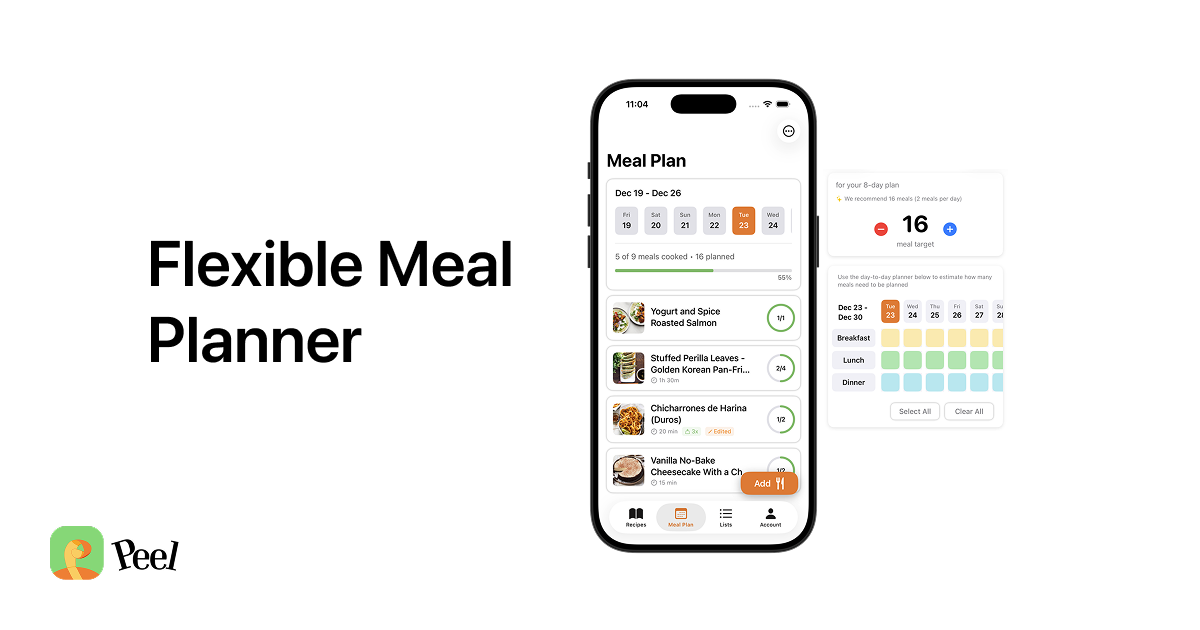
Apps like Peel let you import recipes from TikTok, Instagram, YouTube, and websites into a single collection. You share a video link and the app extracts the ingredients and steps automatically. This means both parents (and older kids) can save recipes whenever they find something good, and everything lands in the same shared library.
2. Tag recipes by who will eat them
This is where family meal planning gets specific. Not every recipe works for every family member, and pretending otherwise leads to dinnertime standoffs.
Tag your recipes honestly:
- Crowd-pleasers: Everyone will eat this without negotiation. Tacos, pasta with red sauce, grilled chicken with rice.
- Adventurous picks: One or both parents want to try something new. The kids might need a backup option.
- Kid-approved: Simple enough for even the pickiest eater. Think sheet pan chicken, quesadillas, or that specific mac and cheese brand they'll accept.
- Quick meals: Under 30 minutes, for nights when practice runs late or nobody has energy.
A good weekly pool for a family of four might look like: 3 crowd-pleasers, 2 kid-approved meals, 1 adventurous pick, and 1 quick-meal backup. That gives you seven options with room to flex.
3. Plan the week in 15 minutes
With a stocked meal pool, your weekly planning session drops from a 30-minute negotiation to a 15-minute sorting exercise. Open the pool, look at the week ahead, and loosely slot meals based on your schedule:
- Busy weeknights: Pull from quick meals or kid-approved tags
- Weekend with more time: That's when the adventurous TikTok recipe gets its shot
- Night one parent is out: Kid-approved meal, no debate
You're not locked into this order. If Wednesday arrives and nobody wants the stir fry you loosely planned, swap it for something else from the pool. The ingredients are already on your grocery list either way.
4. Use one shared grocery list
One of the biggest sources of waste for families is disconnected shopping. One parent goes to the store after work with a mental list. The other orders from Instacart. Nobody checked if there were onions in the pantry.
When your meal pool generates a grocery list automatically, everyone works from the same list. Peel's shared grocery list syncs between partners in real time. Add items from your meal pool, check things off at the store, and avoid the "I thought YOU were getting the chicken" conversation.
The app also combines ingredients across recipes. If three of your pooled meals call for onions, you see "onions (3)" instead of buying onions three separate times.
Handling the hard parts
The picky eater problem
Every family meal planning guide mentions picky eaters, but most just say "get them involved in cooking!" as if that solves anything. Here's what actually works:
Build a "safe foods" section in your meal pool. These are the 5 to 8 meals your pickiest eater will reliably eat. They're always available as a fallback. The goal isn't to force new foods. It's to have a system where the picky eater is fed and happy while the rest of the family can try something different if they want.
Parallel cooking, not separate cooking. On adventurous nights, cook the main meal for the adults and one side or component the kids will eat. Grilled salmon with roasted vegetables for the parents, plain rice and steamed broccoli for the kid who's suspicious of anything with sauce. Same kitchen, same dinner time, less resentment.
Let picky eaters add to the pool. If your kid gets to pick two meals for the week's pool, they feel ownership over the plan. That goes a long way toward reducing resistance on the nights they didn't pick.
Weeks that don't look like other weeks
Family schedules are unpredictable by nature. School events, work travel, sports tournaments, sleepovers. No two weeks are the same. A rigid 7-day meal plan assumes a stable week that doesn't exist.
The pool approach handles this because you're not locked into a sequence. Going to a birthday party Saturday? One fewer meal from the pool. Partner traveling for work? Pull simpler meals to the front. Kid home sick? Soup from the crowd-pleaser list.
You're making decisions in the moment with options you already prepared for. That's the difference between planning and scheduling. Planning gives you options. Scheduling gives you obligations.
If irregular weeks are your norm, we wrote a whole guide on meal planning when your schedule changes every week.
Getting your partner on board
If you're reading this, you're probably the one who does most of the meal planning. Getting a partner to contribute to the pool is easier than getting them to plan meals from scratch, because the barrier is so much lower.
"Find two recipes you'd want to eat this week" is a much easier ask than "plan all our dinners." Most people can scroll their TikTok or Instagram saves and pick two things in under five minutes. In our guide to meal planning for couples, we cover how to split the planning workload so it doesn't all land on one person.
What this looks like in practice
Here's a sample week for a family of four using the pool approach:
The pool (built Sunday, 15 minutes):
- Sheet pan fajitas (crowd-pleaser)
- One-pot garlic butter pasta (kid-approved, quick)
- Korean beef bowls (adventurous, mom's TikTok find)
- Chicken quesadillas (kid-approved)
- Salmon with roasted vegetables (crowd-pleaser, adults love it, kids get plain rice + veg on the side)
- Crockpot chili (crowd-pleaser, makes leftovers)
- Frozen pizza + salad (quick backup)
How the week actually plays out:
- Monday: Fajitas (planned, everyone's fresh)
- Tuesday: Quesadillas (soccer practice ran late, needed something fast)
- Wednesday: Korean beef bowls (had the energy, kids tried it, one liked it, one had leftover chili)
- Thursday: Garlic butter pasta (easy night, no complaints)
- Friday: Frozen pizza (it's Friday, nobody's cooking seriously)
- Saturday: Salmon night (more time to cook properly)
- Sunday: Leftover chili (barely had to do anything)
Notice that the plan shifted from whatever was loosely intended. That's fine. Everything was in the pool, the groceries were bought, and nobody ate cereal for dinner out of desperation.
A note about apps that plan for you
Apps like Ollie and NumYum use AI to generate meal plans based on your family's dietary needs. They pick the recipes for you from their own database, which is appealing if you want someone else to do the thinking.
The tradeoff is you're eating what an algorithm picks, not what you actually found and wanted to cook. If your family has strong opinions about food (and most families do), AI-generated plans run into the same problem as any top-down plan, people don't eat what they didn't choose.
Peel takes the opposite approach. You find recipes you want from TikTok, Instagram, YouTube, or anywhere else. You build the pool together. Peel handles the grocery list and planning structure, but the recipes are yours. Premium is $2.99/month or $29.99/year if you want unlimited social media imports and shared kitchen features. The free tier lets you try it with a few imports first.
Start with what your family already eats
You don't need to overhaul your dinners to start meal planning as a family. Take the 5 to 7 meals you already rotate through (the ones everyone tolerates) and put them in a pool. That's your baseline.
From there, add one new recipe per week. Maybe it's something you saw on TikTok. Maybe your kid wants to try making pizza from scratch. The pool grows over time, and so does your family's comfort with variety.
The hardest part of feeding a family isn't finding recipes or following a plan. It's getting four different people to agree on what's for dinner. A shared meal pool doesn't eliminate disagreements, but it moves the negotiation to Sunday afternoon when everyone's calm instead of 6 PM on a Tuesday when everyone's hungry.
Build the pool. Shop from the list. Cook what sounds good.
Last updated: March 2026