Every meal planning guide assumes the same thing: that your weeks look roughly the same. Monday through Friday, predictable hours, dinner at 6:30. But what if your schedule changes every single week? Shift work, freelance projects, kids' activities that rotate, travel weeks mixed with home weeks. The standard advice doesn't work for you—and that's not your fault.
If you've tried meal planning and quit because your life is too unpredictable, you weren't doing it wrong. You were using a system designed for a life you don't have. Here's what actually works when no two weeks look the same.
Why Traditional Meal Planning Fails Unpredictable Schedules
Traditional meal planning is built on a calendar. Monday: chicken stir-fry. Tuesday: salmon. Wednesday: tacos. It looks organized and satisfying on a Pinterest board. But it breaks immediately when reality doesn't match the plan.
When your schedule is unpredictable, here's what actually happens:
- You don't know which nights you'll be home. That Tuesday salmon? Useless if you get called into a late shift or your kid's practice runs long.
- Your energy varies wildly. After a 12-hour day, you're not making a 45-minute recipe. But the plan says you should.
- Time windows shift. Some nights you have two hours. Some nights you have 20 minutes. A rigid plan can't account for that.
- Ingredients go bad. When you skip planned meals because life got in the way, the groceries you bought for those meals go to waste.
The result? You abandon the plan by midweek, feel guilty, order takeout, and tell yourself meal planning "doesn't work for people like me."
But the problem was never you. The problem was the rigid calendar approach itself.
The Schedule Types That Break Meal Plans
If any of these sound familiar, you're exactly the person who needs a different approach:
Shift Workers and Rotating Schedules
Nurses, retail managers, warehouse workers, first responders—anyone whose shifts rotate weekly or biweekly. You might work 7am-3pm one week and 3pm-11pm the next. "Dinner" might be at 4pm or midnight. A Monday-through-Friday meal plan is meaningless.
Freelancers and Remote Workers With Variable Hours
Your workload changes week to week. Some weeks you wrap up at 4pm and have time to cook something involved. Other weeks you're deep in a project until 8pm and need something that takes 15 minutes. You can't predict which week is which.
Parents With Rotating Activities
Soccer on Monday this month, but Wednesday next month. Swim practice that moves to a different day each season. Nights when both kids have activities versus nights when everyone's home. Your evening schedule is a moving target.
People Who Travel for Work
Home three days, traveling two. But which days change. Buying a full week of groceries when you'll be gone half the week means food waste. Not planning at all means takeout every night you are home.
The Flexible Alternative: Pool-Based Meal Planning
Here's the approach that actually works for unpredictable lives: instead of planning what to eat on which day, you build a pool of options and decide in the moment.
I built Peel around this after years of planning our family's week Monday through Sunday, feeling good about it, and then watching the whole thing fall apart the second a random Thursday event came up. That wasn't just inconvenient, it felt like failure. So I stopped filling slots and started filling a pool, because the pool flexes and a calendar doesn't.
Pool-based meal planning separates the two parts of meal planning that traditional systems combine:
- The planning part (deciding what recipes to have available and buying ingredients) happens once, in advance.
- The choosing part (deciding what to actually cook tonight) happens in the moment, when you know what your day actually looked like.
This matters because planning requires calm and focus. Choosing requires flexibility and responsiveness. A rigid calendar tries to do both at once—and fails at the second one.
Plan the ingredients in advance. Choose the recipe in the moment. That's the entire system.
How to Meal Plan Around an Irregular Schedule
Here's a step-by-step method that works whether your schedule changes weekly, daily, or somewhere in between.
Step 1: Pick a Flexible Time Window
Instead of planning Monday through Sunday, choose a window that makes sense for your life. Maybe it's 5 days. Maybe it's 10. If your schedule comes out biweekly, plan biweekly. If you only know a few days ahead, plan in shorter blocks.
The window doesn't need to start on Monday. It doesn't need to follow any calendar convention. It just needs to match your reality.
Step 2: Estimate Your Cooking Nights (Loosely)
Don't try to nail down exactly which nights you'll cook. Just estimate roughly how many home-cooked meals you'll want. If you're home 5 nights but know 2 will be late, plan for 3-4 recipes with leftovers covering the rest.
Be honest and generous with yourself. If you plan 7 recipes but only cook 4, that's 3 meals of wasted groceries. It's better to plan 5 recipes and add a bonus if you're feeling ambitious.
Step 3: Build Your Pool With Variety in Effort Level
This is the key insight for irregular schedules. Your pool should include a mix of:
- Quick meals (under 20 minutes): Pasta with jarred sauce, quesadillas, stir-fry with pre-cut vegetables, sheet pan meals with minimal prep. These are your "exhausted Tuesday" options.
- Medium-effort meals (30-45 minutes): One-pot soups, baked chicken with roasted vegetables, grain bowls. For nights when you have moderate time and energy.
- Batch-cook options (when you have time): Chili, curry, casseroles—things that make enough for 2-3 meals. Cook once on a day off, eat multiple times during the busy stretch.
When you come home after a long day, you scan your pool and grab the option that matches your energy. No guilt. No rearranging the calendar. Just pick what works right now.
Step 4: Shop for Everything at Once
With your pool set, buy all the ingredients in one trip. This is the whole point of planning ahead—you don't end up at the grocery store at 6pm on a random Wednesday trying to figure out dinner.
A smart grocery list that pulls from your entire pool is ideal. It combines duplicate ingredients (if three recipes need onions, you see "onions" once with the right total) and organizes by category so you move through the store efficiently.
Step 5: Decide Each Day Based on Reality
This is where the system pays off. Each day, look at your pool and ask three questions:
- How much time do I actually have tonight?
- How much energy do I have?
- What sounds good right now?
Then pick the recipe that matches. Maybe it's the 15-minute pasta because you just worked a double. Maybe it's the curry because you have a rare evening off and want to cook something satisfying. Every choice is a good choice, because every option in your pool was pre-approved by you.
Tips for Specific Schedule Challenges
If You Work Rotating Shifts
Build your pool around your shift pattern, not the calendar. When you're on early shifts, you might have energy to cook in the evening. When you're on late shifts, prep something in the morning or rely on batch-cooked meals. Include at least two "no-cook" options (salads, wraps, grain bowls from prepped ingredients) for transition days when your body clock is adjusting.
If You Travel Regularly
Plan only for the days you'll be home. If you know you're traveling Tuesday through Thursday, build a pool for Monday, Friday, Saturday, and Sunday. Choose recipes with ingredients that keep well in case your travel schedule shifts by a day. Frozen proteins and shelf-stable sides are your best friends.
If Your Kids' Schedule Changes Monthly
Keep a "greatest hits" pool—10-12 family-tested recipes that you rotate through regularly. When the activity schedule drops each month, look at which nights will be hectic and make sure your pool has enough quick options for those weeks. Save the more involved recipes for the calmer stretches.
If You're Cooking for Two With Different Schedules
Build the pool together so both people have options they like. On nights when only one person is home, they pick from the pool independently. On nights you're both home, choose together. A shared grocery list keeps you from duplicating purchases.
The Pool Method vs. the Calendar Method
Here's the practical difference for someone with an unpredictable schedule:
- Calendar method: Plan Monday=tacos, Tuesday=salmon, Wednesday=pasta. Tuesday you work late, skip salmon. Wednesday the salmon is still there, but you already have pasta planned. By Thursday the salmon is questionable. You throw it out.
- Pool method: Pool has tacos, salmon, pasta, stir-fry, soup. Tuesday you work late, make the 15-minute pasta. Wednesday you have time, make the salmon. Nothing wasted. No guilt. The stir-fry and soup are still there for whenever they fit.
The same groceries, the same recipes, the same effort. The only difference is when you decide what to cook, and that makes all the difference for unpredictable schedules. It is also the main thing to look for when you compare options in a guide to the best meal planning app: does it lock you into days, or let you cook what fits?
An App Built for This
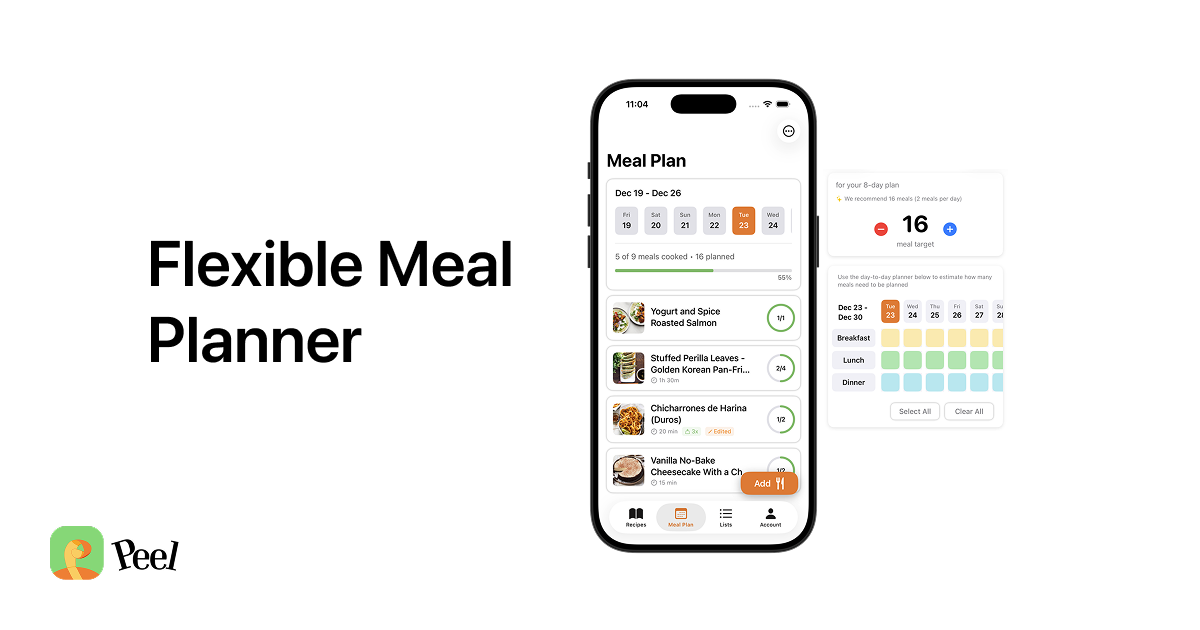
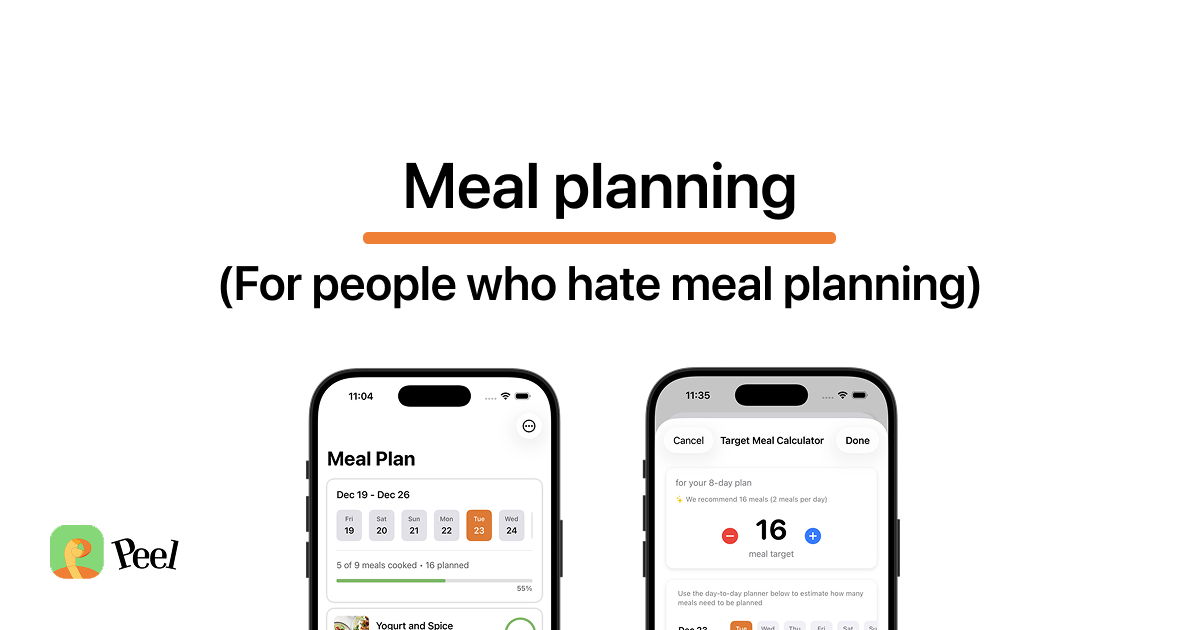
Peel is a meal planning app designed around the pool concept, and it earns a spot on our list of the best free meal planning apps for exactly this reason. Instead of a calendar grid, you get a flexible meal pool where you add recipes for a time window you choose. It auto-generates your grocery list from the pool, and you pick what to cook each day based on your actual schedule.
You can save recipes from TikTok, Instagram, websites, or add your own. Build your pool in a few minutes on a day off, shop once, and let the rest happen naturally.
It is a very different promise from the AI meal planners that try to generate your whole week, which usually hand you back the same rigid calendar that broke on you in the first place. The concept works without an app too, a notes app or even a sticky note on the fridge works. The important thing is the mindset shift: plan ingredients, not days. Build options, not obligations.
Frequently Asked Questions
How do you meal plan with an irregular schedule?
What is pool-based meal planning?
How do shift workers meal plan?
Is there a meal planning app for unpredictable schedules?
Last updated: August 2026