HelloFresh confirmed in February 2026 that Factor, its prepared meal delivery brand, will wind down by the end of this year. If you've been relying on Factor for weeknight dinners, you're probably wondering what comes next.
Most articles about the shutdown point you toward other delivery services like CookUnity or Fresh n' Lean. That's one option. But there's another one worth considering: cooking for yourself.
I know. If cooking were easy for you, you wouldn't have signed up for Factor in the first place. But here's the thing I keep hearing from ex-Factor subscribers: the cooking was never the hard part. The hard part was figuring out what to make, buying the right ingredients, and doing that every single week without losing your mind.
That's a planning problem, not a cooking problem. And planning problems have solutions.
Why you actually used Factor
Factor cost between $11.49 and $13.99 per meal, plus $10.99 shipping per box. On a 6-meal plan, that's roughly $80 to $95 per week. Nobody paying that much thought it was cheap.
You paid it because Factor removed every decision from your plate (literally). No browsing recipes. No grocery shopping. No "what are we having tonight?" at 5:30 PM. The food just showed up, you heated it, and dinner was handled.
That's not laziness. That's decision fatigue. And it affects more people than you might expect. A 2026 YouGov survey reported by USA Today found that while 75% of Americans cook at least a few times per week, the biggest friction point isn't skill. It's the mental overhead of deciding, planning, and shopping.
Factor sold you relief from that overhead. The food itself was almost secondary.
The problem with switching to another delivery service
The obvious move is to find a Factor replacement. CookUnity, Trifecta, Fresh n' Lean all do something similar. But consider what happened to Factor: HelloFresh acquired it for $277 million in 2020, scaled it to millions of meals per week, and is now shutting it down because the business model doesn't work.
This isn't just a Factor problem. HelloFresh's total orders dropped 12% in 2025. They delivered 100 million fewer meals than the year before. Revenue fell 11%. Their stock is down 93% from its 2021 peak. They're pulling out of Italy and Spain entirely.
The prepared meal delivery model is contracting across the board. Freshly shut down in 2023. Factor is following. Signing up for the next delivery service means betting that they won't hit the same wall.
Meanwhile, the cost gap keeps widening. An average home-cooked dinner runs $3 to $7 per serving for ingredients. Even on the high end, you're spending less than half what Factor charged. Over a year, that difference adds up to hundreds in savings, depending on how many meals per week you were ordering.
What home cooking actually requires (less than you think)
Here's what you don't need to start cooking at home:
- You don't need to cook every night. Three to four home-cooked dinners per week is plenty. That matches how most Factor subscribers actually used the service anyway.
- You don't need 50 recipes. Start with 10 to 15 meals you know you like or want to try. That's enough for a month of variety.
- You don't need to be creative. If the same rotation of chicken stir-fry, sheet pan salmon, and pasta shows up every other week, that's fine. Repetition is normal.
- You don't need hours. Most weeknight recipes take 30 minutes or less. Factor meals took 2 minutes to reheat, but you also spent time choosing your weekly box, managing the subscription, and dealing with delivery windows.
What you do need is a system. Not willpower, not inspiration, not a sudden passion for cooking. A system.
Step 1: Build a recipe collection
You probably already have recipes scattered around. Screenshots in your camera roll. TikTok videos you saved months ago. Instagram reels you sent to a friend. A few family recipes stored in your head.
Start by gathering 15 to 20 recipes in one place. They don't need to be fancy. Think about meals you've eaten at restaurants and thought "I could probably make this," or videos you watched and bookmarked.
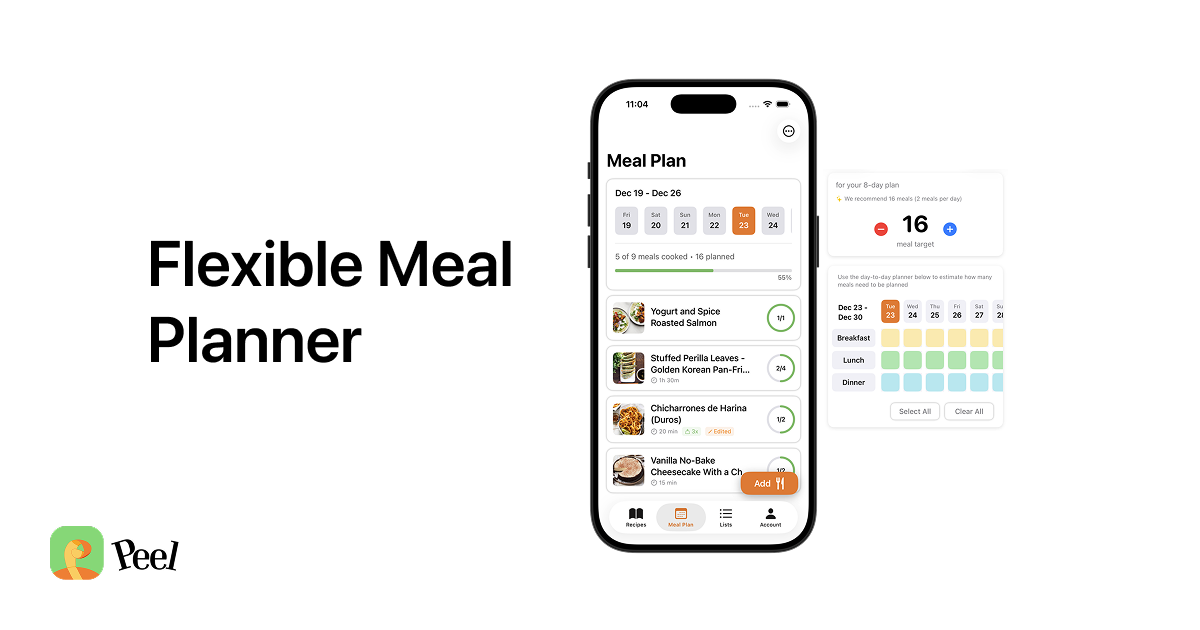
If your recipes are stuck in social media, apps like Peel can extract full ingredient lists and steps from TikTok videos, YouTube, and Instagram reels. You share or paste the link, and you get a proper recipe with measurements and instructions. (Social imports are available on the free tier with a small fixed allowance that does not reset. Unlimited imports require Premium.)
I built Peel because I wanted an affordable way to build my family's kitchen over a lifetime. The goal isn't a perfect week: it's building a collection of meals you actually want to cook, so the grocery list matches how you really eat.
For website recipes, most recipe apps can import directly from a URL. The goal is to get everything into one searchable collection instead of scattered across five apps and your camera roll.
Step 2: Organize your meal pool
Once you have a collection, sort your recipes loosely by effort level:
- Quick wins (under 20 minutes): Pasta dishes, stir-fries, grain bowls, anything that's basically "heat protein + add sauce + serve over starch."
- Standard weeknight (20 to 40 minutes): Sheet pan meals, curries, tacos, soups.
- Weekend projects (40+ minutes): Slow-cooked dishes, homemade pizza, anything you'd make when you have time and energy.
This is your meal pool. The idea is borrowed from flexible meal planning: instead of assigning Monday = chicken, Tuesday = fish, Wednesday = pasta (which falls apart the first time your schedule changes), you keep a rotating pool of options and pick what fits your energy level each night.
Most apps hand you a rigid Monday-through-Sunday calendar. When something comes up mid-week, the plan falls apart and it feels like failure. A pool of options lets you shop once for the week, then choose what sounds good that night. No slot needs to be filled.
It's the same freedom Factor gave you when you browsed their weekly menu, except the options are recipes you actually chose.
Step 3: Plan 3 to 4 nights per week
Pick 3 to 4 recipes from your pool for the upcoming week. That's it. Leave the other nights open for leftovers, takeout, or a frozen pizza.
This takes about 10 minutes on a Sunday. Some people do it while drinking coffee. Some do it in the grocery store parking lot. The point is that the decision happens once, not seven times.
If you're cooking for one, scale recipes down or lean into meals that reheat well for lunches the next day. Two dinners that yield leftovers can cover most of your weekday eating.
Step 4: Make one grocery list, shop once
From your 3 to 4 selected recipes, combine all the ingredients into a single grocery list. Cross off anything you already have. Shop once.
This is where a tool saves time. Peel generates a combined grocery list from whatever recipes you've selected for the week, merging duplicate ingredients automatically. If two recipes need onions, your list says "onions" once, not twice.
One shopping trip per week. That's the same frequency as Factor's delivery schedule, minus the $10.99 shipping fee.
The cost breakdown
Let's compare a typical week:
Factor (6 meals/week):
6 meals at $12.49 average = $74.94, plus $10.99 shipping. Weekly total: roughly $86. Monthly total: roughly $344.
Home cooking (4 dinners/week, 2 servings each):
8 servings at $5 average per serving = $40. Monthly total: roughly $160.
That's around $180 per month back in your pocket, or over $2,000 per year. And that $5 per serving estimate is generous. Many home-cooked meals come in well under that.
The savings get more significant if you were on Factor's larger plans. A 10-meal/week subscription ran $120 to $140 per week before shipping.
Your first week: a starter plan
If you want something concrete, here's a no-pressure first week:
Sunday: Pick 3 recipes from your collection. Anything that sounds good. Write down the ingredients. Go shopping.
Monday: Cook recipe #1. Make enough for leftovers.
Tuesday: Eat leftovers from Monday.
Wednesday: Cook recipe #2.
Thursday: Takeout or freezer meal. Give yourself the night off.
Friday: Cook recipe #3 or eat leftovers from Wednesday.
Saturday: Whatever you want.
That's three cooking sessions for a full week of eating. Factor was handling roughly the same number of meals for you. This just puts you in control of what those meals are.
Tools that make the transition easier
You can do all of this with a notebook and a pen. But if you want something more organized:
- Peel saves recipes from TikTok, Instagram, YouTube, and websites. It has a meal pool system, weekly planning, and generates a combined grocery list. Free accounts can also send recipes and meal plans to connections through the app; Partner kitchen (Premium) gives two people a shared live kitchen. For a broader comparison, see our best meal planning apps roundup.
- A simple spreadsheet works if you prefer low-tech. List your recipes in one tab, plan your week in another.
- A physical recipe binder is still a valid system. Print your favorites, organize by type, and flip through when planning.
The tool matters less than the habit. Pick whatever you'll actually use.
You already know more than you think
Here's what I find interesting about Factor subscribers. You weren't people who didn't care about food. You chose your meals from a weekly menu. You had preferences. You knew you liked the garlic herb chicken better than the turkey meatballs. You read the macros. You picked your box carefully.
That's meal planning. You were already doing it, just inside Factor's interface instead of your own kitchen.
The transition from "choose meals from a subscription" to "choose meals from your own recipe collection" is shorter than it seems. You're not learning a new skill. You're applying one you already have to a different set of options.
Factor is going away. But the thing it actually gave you (a system for deciding what to eat without the nightly debate) is something you can build yourself. It takes a Sunday afternoon to set up, 10 minutes a week to maintain, and it costs a fraction of what you were paying.
The meals will be better, too. They'll be recipes you picked because they actually looked good to you, not because they were on this week's menu.
Last updated: March 2026