You bought a bunch of cilantro for one recipe and watched the rest of it turn to slime in your fridge. You've made a full pot of chili that took you four days to eat. And at some point, you probably just ordered takeout because cooking a real meal for one person felt like more trouble than it was worth.
Cooking for one has a specific set of problems that meal planning advice almost never addresses. Most guides assume you're feeding a family of four. They tell you to batch cook five pounds of chicken on Sunday, fill a dozen containers, and eat the same lunch all week. If that worked for you, you wouldn't be reading this.
Our comparison of the best meal planning apps helps identify which tools can adapt to a solo kitchen instead of assuming family-sized portions.
Here's what actually works when you're the only person eating.
Why cooking for one is harder than it looks
The standard grocery store isn't set up for solo cooks. Produce comes in bags. Meat is packed for families. Recipes default to four servings. The whole system assumes someone else is eating with you.
This creates two problems that feed into each other:
You buy too much. A head of lettuce, a full bunch of bananas, a package of chicken thighs with six pieces. You only needed half of that, but they don't sell half.
Then you waste what you bought. According to Penn State researchers, American households waste close to a third of the food they buy. That number is often worse for single-person households because portion math just doesn't work out. The USDA estimates food waste at about 325 pounds per person per year.
The result: you spend more on groceries than you should, throw food away regularly, and eventually give up on cooking because the economics feel broken.
The meal pool approach for solo cooks
Instead of planning out seven specific dinners for the week (which almost never happens when you're cooking for one), try building a meal pool.
A meal pool is a collection of 4-5 recipes you'd be happy eating this week. You don't assign them to specific days. You just pick from the pool each night based on what you feel like, how much energy you have, and what needs to be used up first.
This works better for solo cooks for a few reasons:
- You're not locked into eating something specific on Tuesday when Tuesday turns out to be a 12-hour day
- You can pick the recipe that uses the ingredients closest to going bad
- If you end up eating out one night, nothing goes to waste because the recipes just carry over
- Your grocery list stays small because 4-5 recipes for one person is a manageable shopping trip
Building your recipe collection
The first step is having recipes worth cooking. Not elaborate four-course meals. Simple, one-to-two serving recipes that you actually want to eat.
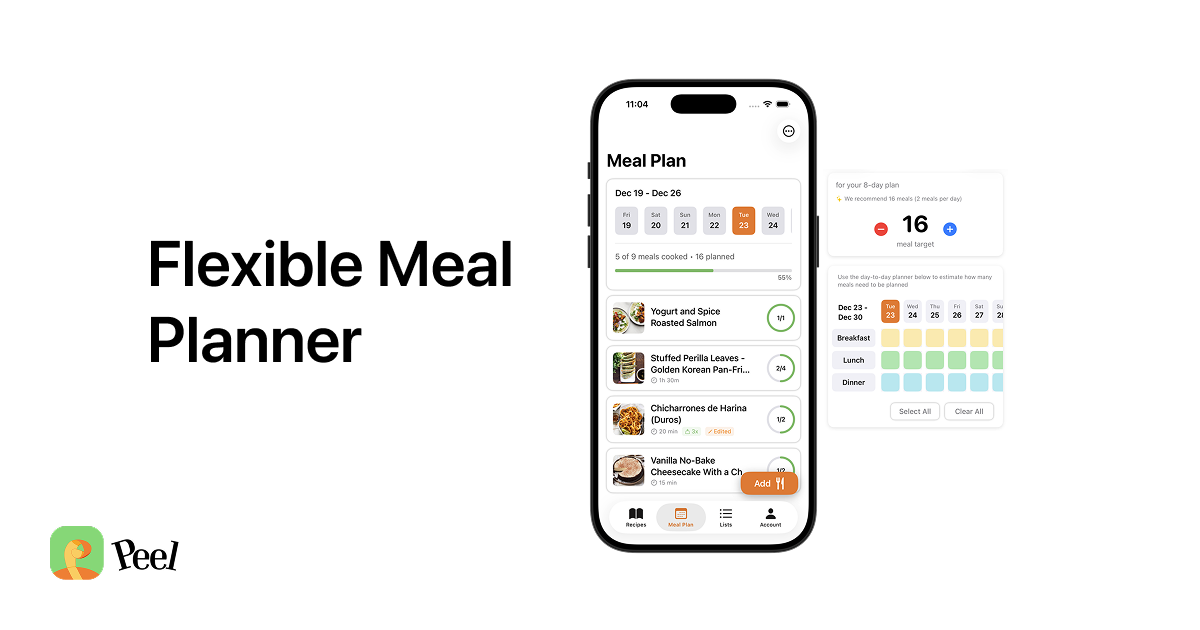
The best source? Whatever you're already finding. If you scroll through TikTok or Instagram and see something that looks good, save it properly instead of taking a screenshot you'll never find again. Apps like Peel let you share a video link and get back a real recipe with ingredients and steps.
Once you have 15-20 recipes that you know you like and can actually make, meal planning becomes a lot easier. You're not deciding what to cook from scratch every week. You're picking 4-5 favorites from a collection you've already built.
For more on getting your recipes organized, check out our guide on how to organize your recipes digitally.
Grocery shopping for one without overbuying
The grocery store is where solo cooking plans usually fall apart. Here's how to make it work:
Shop your kitchen first. Before you plan anything, look at what you already have. That half-used bag of rice, the can of chickpeas in the back of the cabinet, the frozen chicken breast you forgot about. Plan at least one meal around something you already bought.
Pick recipes with overlapping ingredients. If one recipe uses bell peppers and another uses half an onion, you're less likely to waste the other half of each. When building your weekly pool, look for ingredient overlap. A stir-fry and a grain bowl might share the same vegetables.
Use your freezer more than you think. Bread, meat, cheese, herbs, cooked grains, soups. Almost everything freezes well. When you cook a recipe that makes three servings, freeze two of them immediately. Future you will appreciate having a home-cooked meal ready on a night you don't feel like cooking.
Buy frozen vegetables without guilt. Fresh produce goes bad fast when you're the only one eating it. Frozen vegetables are picked and frozen at peak ripeness, they're often cheaper, and you use exactly what you need without wasting the rest. Frozen spinach, peas, corn, broccoli, and stir-fry mixes are all solid options.
Hit the bulk bins and salad bar. Many grocery stores have bulk sections where you can buy exactly the amount of rice, nuts, spices, or grains you need. Some have salad bars where you can grab pre-cut vegetables in small quantities. Use them.
The "cook once, eat twice" strategy
Batch cooking for families means making huge quantities. Batch cooking for one means making two servings of something instead of one.
This is the most practical solo cooking hack. When you make dinner, double the recipe. Eat one serving tonight and put the other in the fridge for tomorrow's lunch or dinner. You cook once but eat twice.
Some meals lend themselves to this better than others:
- Soups and stews (actually taste better the next day)
- Curries
- Grain bowls with different toppings
- Pasta sauces (cook fresh pasta, reheat yesterday's sauce)
- Rice and beans in various combinations
The key is not eating the same thing three or four days in a row. Two days is fine. By day three, most people are sick of it and end up ordering delivery.
The "ingredient cascade" method
This is where solo meal planning gets interesting. Instead of treating each recipe as independent, plan your week so that one recipe's leftovers become another recipe's ingredients.
Here's an example:
- Monday: Roast a whole chicken with vegetables. Eat half for dinner.
- Tuesday: Use leftover chicken in a chicken salad or wrap for lunch. Use the other half of the roasted vegetables in a grain bowl for dinner.
- Wednesday: Strip remaining chicken off the bone. Make chicken soup using the carcass for broth if you're ambitious, or just use store-bought broth with the leftover meat and whatever vegetables need using up.
Three different meals from one cooking session, plus you've used nearly everything you bought. Nothing sits in the fridge getting weird.
This takes a bit of planning, but once you get the hang of it, you stop thinking about individual recipes and start thinking about ingredients as flexible building blocks.
When cooking for one feels pointless
There's a mindset problem with solo cooking that nobody talks about enough. It can feel like a lot of effort for "just you." Setting up, cooking, and cleaning for one person sometimes feels disproportionate to the payoff.
A few things that help:
Lower the bar for what counts as cooking. An omelet with whatever vegetables are in the fridge is cooking. Toast with avocado and a fried egg is cooking. You don't need to produce restaurant-quality plates to call it a meal.
Make the experience matter, not just the food. Put on a podcast. Pour yourself a drink. Use a real plate instead of eating out of the pan. Small things that make cooking for yourself feel like something you're doing for yourself, not a chore you're stuck with.
Track how much you save. If you usually spend $15 on takeout per meal and eat out four times a week, that's $240/month just on dinners. Cooking those same meals at home, even for one person, probably costs $5-8 each. The math adds up fast.
A sample week of meal planning for one
Here's what a realistic week looks like using the meal pool approach:
Your pool (5 recipes)
- Sheet pan chicken and vegetables
- Black bean tacos
- Pasta with garlic and broccoli
- Fried rice with whatever's in the fridge
- Simple soup (canned broth + vegetables + protein)
Groceries needed
One package chicken thighs (freeze half immediately), one can black beans, broccoli, garlic, pasta, rice, eggs, tortillas, a bag of frozen mixed vegetables, one onion, chicken broth. Total: probably $20-30 depending on what you already have.
How the week plays out
- You make the sheet pan chicken Monday. Eat half, fridge the rest.
- Tuesday you're tired, so you make the pasta (15 minutes).
- Wednesday you use leftover chicken in fried rice with frozen vegetables.
- Thursday is tacos. Quick, easy, different flavor profile.
- Friday you eat out with friends. The soup ingredients carry into next week.
- Weekend you make the soup with whatever vegetables need using up.
No food wasted. No sad desk lunches. No "I have nothing to eat" moments when there's a full fridge.
Making it stick
The biggest risk with meal planning for one is overthinking it. You don't need a perfect system. You need a system that's slightly better than what you're doing now.
Start with three recipes you already know how to make. Add them to your pool. Buy the ingredients. Cook when you feel like it. That's the whole system.
If you want help keeping your recipes organized and your grocery list generated automatically, Peel does that. The free tier is enough to get started, and Premium is $2.99/month or $29.99/year if you want unlimited recipe imports from TikTok and Instagram.
But the app is optional. The system is what matters. Pick recipes you want to eat, buy only what you need, and give yourself permission to keep it simple.
Last updated: March 2026