You asked ChatGPT to plan your meals for the week. It gave you a tidy Monday-through-Sunday grid with balanced macros and a grocery list. You felt productive for about ten minutes. Then Tuesday came, you weren't in the mood for chicken stir-fry, and the whole plan fell apart.
AI chatbots are genuinely useful for certain parts of meal planning. But after testing ChatGPT, Gemini, and Grok for meal planning over several weeks, the pattern is clear: they're better at brainstorming than at building a system you'll actually stick with.
Here's an honest breakdown of what each tool does well, where they all struggle, and when you're better off using a dedicated app.
If you are comparing dedicated options too, start with our broader guide to the best meal planning apps and then use this AI comparison to narrow the field.
I built Peel, so I should be upfront: Peel is not an AI meal planner. It's a gathering place. You bring your own recipes from wherever you find them (TikTok, Instagram, recipe sites, even a photo of a cookbook page), build a pool of options, and shop once for the whole pool. AI generates meal ideas on demand; Peel stores the meals you've already decided you want to make. That's a different job, and it's worth keeping the distinction clear.
What ChatGPT does well for meal planning
ChatGPT is the most popular option for AI-assisted meal planning, and for good reason. It handles open-ended requests better than most tools.
Where it shines:
- Generating recipe ideas when you're stuck. Tell it your dietary restrictions and what's in your fridge, and it'll come back with reasonable suggestions.
- Adapting recipes. "Make this vegetarian" or "scale this to feed six" works surprisingly well.
- Creating a grocery list from a set of recipes, at least for a single conversation.
- Explaining cooking techniques. If you don't know how to braise something, ChatGPT gives a decent walkthrough.
The catch: every conversation starts from zero. ChatGPT doesn't remember that you hate cilantro, that you made Thai food last week, or that your partner is allergic to tree nuts. You have to re-explain your preferences every single time, or maintain a running prompt you paste in. That gets old fast.
What Gemini brings to the table
Google's Gemini has one interesting advantage: if you use it through Google's ecosystem, it can pull context from your Gmail, YouTube history, and other Google services via Personal Intelligence (launched January 2026).
Where it shines:
- Integration with Google services. If you watch cooking videos on YouTube, Gemini might reference them.
- Structured output. Gemini tends to format meal plans in clean tables without much prompting.
- Grocery list generation with reasonable categorization (produce, dairy, pantry, etc.).
The catch: the Google integration sounds better on paper than it works in practice. Gemini's meal suggestions still lean generic. It doesn't know what recipes you've saved, what you cooked last week, or what your family actually eats. The context it pulls from your Google account is shallow at best.
What Grok offers (and doesn't)
Grok, xAI's chatbot available through X (Twitter), positions itself as less filtered than ChatGPT. For meal planning, that personality difference doesn't matter much.
Where it shines:
- Speed. Grok generates responses quickly.
- Casual tone. If ChatGPT's meal plans feel overly structured, Grok's conversational style might click with you.
- Real-time X integration. If a recipe is trending on X, Grok might surface it.
The catch: Grok has the same fundamental limitations as the others. No memory between sessions, no recipe storage, no grocery list that persists after you close the chat. Its real-time X integration is more of a novelty than a practical meal planning feature.
The problems all three share
After spending time with each tool, the limitations start to blur together. These aren't bugs specific to one model. They're structural problems with using a chatbot for meal planning.
They forget everything between sessions
This is the biggest one. You can spend 20 minutes telling ChatGPT about your family's preferences, your schedule, your budget, and your kitchen equipment. Close the chat, come back tomorrow, and it's all gone. Gemini and Grok work the same way.
Some people work around this with saved prompts or "system instructions" they paste at the start of each session. That works, technically. But at that point you're maintaining a document that describes your meal planning preferences and copy-pasting it into a chatbot every week. That's not a system. That's a workaround.
Every app I used before building Peel was built around the calendar. AI meal planners make the same mistake, just faster.
They can't save your recipes
When ChatGPT suggests a recipe you like, where does it go? Into a screenshot, a notes app, or copy-pasted into a document. The chatbot itself can't store recipes for you. It can't build a collection over time. It can't pull up "that chicken thing you liked three weeks ago."
This matters because the hardest part of weekly meal planning isn't generating new ideas. It's remembering and reusing the recipes your household already likes.
Their nutrition advice may be unreliable
A peer-reviewed study published in Frontiers in Nutrition (March 2026) tested five AI models, including ChatGPT and Gemini, on their ability to create meal plans for teenagers. The researchers at Istanbul Atlas University compared the AI-generated plans against those created by a registered dietitian specializing in adolescent health.
The results were concerning. AI-generated meal plans underestimated calorie needs by nearly 700 calories on average, which the researchers described as "equivalent to skipping a meal." The AI plans also skewed macronutrients, recommending too much protein and fat while falling short on carbohydrates.
"Diet plans generated by AI models tend to substantially underestimate total energy and key nutrient intake when compared to guideline-based plans prepared by a dietitian," said Dr. Ayse Betul Bilen, the study's lead researcher.
This doesn't mean you shouldn't use AI for recipe ideas. But if you're relying on ChatGPT or Gemini for nutritional guidance, especially for weight management or feeding a family, the output may not be as balanced as it looks.
They generate grocery lists from scratch every time
A meal planning app builds your grocery list from recipes you've already saved and meals you've already planned. An AI chatbot generates a new list from whatever it just suggested, with no connection to what you bought last week or what's already in your pantry.
The result: duplicate purchases, missing staples, and no way to share the list with a partner in real time.
When AI chatbots actually work for meal planning
AI chatbots aren't useless for meal planning. They're just not a complete system. Here's when they genuinely help:
Use ChatGPT, Gemini, or Grok when you need to:
- Brainstorm dinner ideas ("give me five 30-minute chicken dinners that aren't stir-fry")
- Adapt a recipe for dietary restrictions
- Get a quick explanation of a cooking technique
- Generate a one-off grocery list for a specific set of meals
- Break out of a recipe rut
Skip the chatbot when you need to:
- Build a reusable recipe collection
- Plan meals for a household with multiple preferences
- Share a grocery list with someone else
- Remember what worked last week
- Turn social media recipe finds into something you can actually cook from
When a dedicated app makes more sense
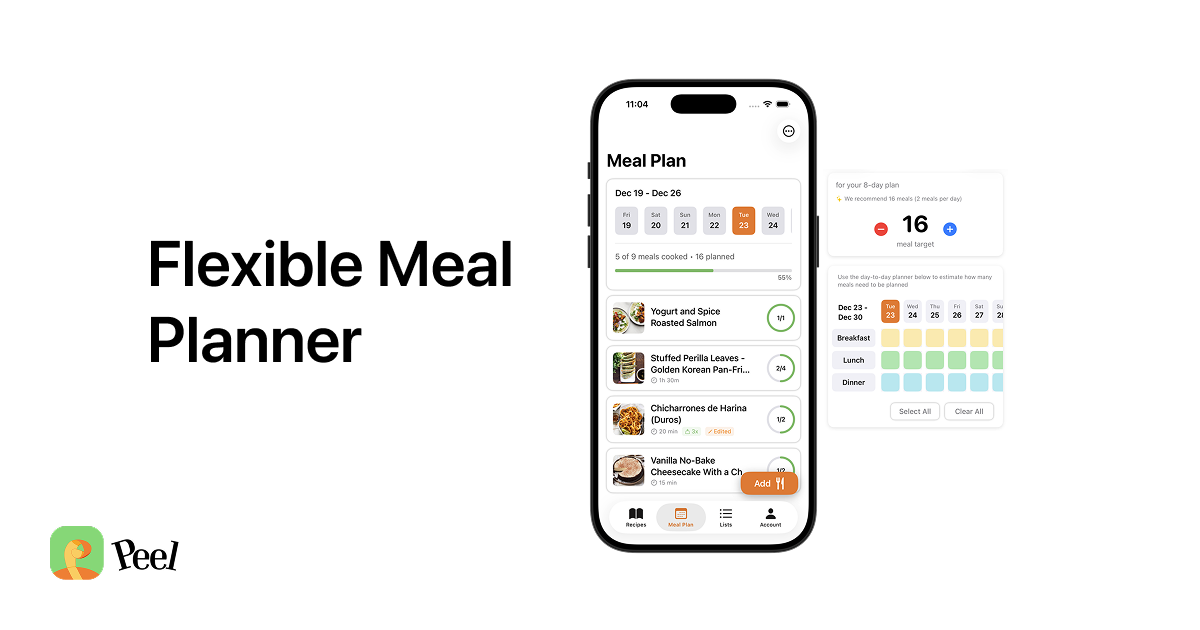
The gap between what AI chatbots do and what meal planning actually requires is pretty specific: you need a place to keep your recipes, a way to plan without rigid day-by-day assignments, and a grocery list that connects to your plan.
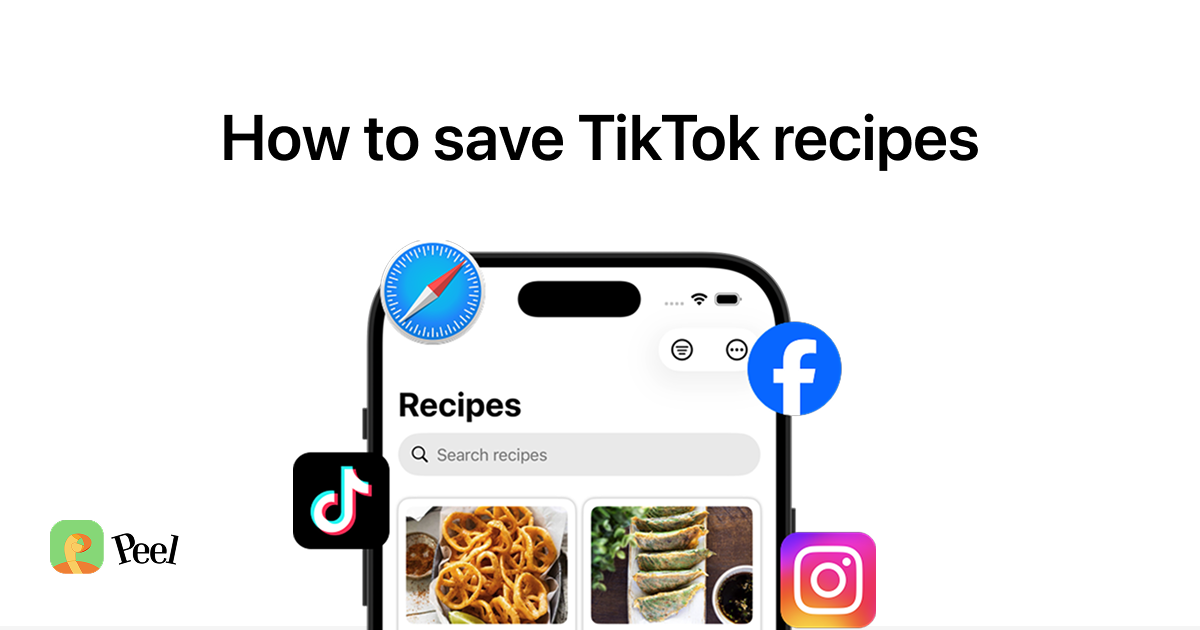
That's what apps like Peel are built for. Instead of generating a fresh meal plan from scratch every week, you build a collection of recipes you've already found and liked, from TikTok, Instagram, YouTube, or any website. Then you pick from that collection each week.
The rigid calendar is where AI meal planning falls apart too. You get a generated plan that doesn't survive the week. A pool of your own recipes lets you choose the day of, so when Thursday goes sideways, nothing breaks.
The difference feels small until you try it. With a chatbot, you're starting from zero every session. With a recipe collection, you're choosing from meals your household has already approved. Your grocery list generates automatically from what you've planned, and your partner can see it in real time. You can also share individual recipes or full meal plans directly with connections through the app, free with an account.
You could also combine the two approaches. Use ChatGPT to discover new recipe ideas, then save the ones you like to an app where they'll actually persist.
The honest verdict
AI chatbots are good idea generators and bad planning systems.
If your problem is "I don't know what to cook," ChatGPT, Gemini, or Grok can help. If your problem is "I have recipes everywhere and can't turn them into a weekly plan," a chatbot will give you more recipes everywhere without solving the actual problem.
The best use of AI for meal planning in 2026 isn't asking a chatbot to plan your whole week. It's using AI as one input into a system that actually remembers what you like, stores your recipes, and connects your plan to a grocery list.
Peel offers a free tier with unlimited recipe imports from websites and social import credits for TikTok, Instagram, and YouTube that refresh every week. Unlimited social imports require Premium, which also adds a shared partner kitchen.
Last updated: March 2026