You work 7pm to 7am three nights, then flip to days for two, then get a random Tuesday off. Traditional meal planning advice was written for people with 9-to-5 jobs. It doesn't work for you.
About 16% of US workers have non-standard schedules, according to the Bureau of Labor Statistics. Nurses, factory workers, first responders, retail staff, warehouse teams. If your schedule rotates, your meals need to rotate with it.
Most meal planning content tells you to assign recipes to specific days. That falls apart the moment your shift changes. What you need instead is a system organized around scenarios, not calendar dates.
Why traditional meal planning breaks down on shift work
The standard advice goes something like: plan your meals on Sunday, prep ingredients, eat what's on the calendar each night. Here's why that collapses for shift workers:
Your "dinner" changes meaning every week. On day shifts, dinner is at 6pm. On nights, you're eating your main meal at 2am. A rigid Tuesday/Wednesday/Thursday plan can't accommodate this.
Energy levels are unpredictable. After a 12-hour overnight, you might have the energy to scramble eggs. You definitely don't have the energy for a 45-minute recipe. But on a rest day, you might actually want to cook something real.
Grocery runs don't happen on a schedule. When your days off shift weekly, you can't count on a Saturday grocery trip. You shop when you can, and you need meals from whatever's in the fridge.
Batch prep spoils before you eat it. If you prep five meals on Monday but work a stretch of 12-hour shifts, that food is questionable by Friday. Shift workers waste more food than they realize because their prep-to-eat timeline is unpredictable.
A 2025 study published in Scientific Reports found that shift workers experience "irregular eating patterns, inadequate nutrient intake and a reliance on convenient foods." Researchers noted that shift workers are more likely to skip meals, especially breakfast, and tend to eat at irregular intervals. The system isn't the worker's fault. The system just wasn't designed for their schedule.
The scenario-based meal pool: how it works
Instead of planning by day, plan by scenario. As a shift worker, you face a handful of recurring eating situations. Build a recipe collection for each one.
Scenario 1: Pre-shift fuel (30 minutes or less)
This is the meal you eat before heading to work. You need something substantial enough to carry you through the first half of your shift, but quick enough that you're not spending your limited pre-work time cooking.
Good pre-shift meals share a few traits: they can be prepped in under 30 minutes, they hold you for 4-5 hours without a crash, and they work whether your shift starts at 6am or 6pm.
Examples: grain bowls with protein, loaded wraps, fried rice with whatever vegetables you have, sheet pan meals that cook while you shower.
Scenario 2: Mid-shift eating (pack and go)
Most shift workers eat at work, often without a real kitchen. Your mid-shift meals need to travel well, taste good cold or microwaved, and be something you can eat in a 15-minute break.
The CDC's nursing shift work module recommends eating "more frequently in smaller amounts" during shifts, focusing on vegetables, whole grains, yogurt, cheese, eggs, and nuts rather than sugar-heavy snacks.
What works: mason jar salads, thermos soups, protein boxes (deli meat, cheese, crackers, fruit, nuts), pasta or grain salads that taste better at room temperature, wraps.
Scenario 3: Post-shift recovery (low effort, fast)
You just worked 12 hours. You're tired. You need to eat something before you sleep, but you also need to actually get to sleep.
This is where most shift workers fall into the drive-through loop. It's 3am, nothing sounds good, and fast food is the only thing open. Having even three or four go-to post-shift meals in your back pocket changes this pattern.
Post-shift meals should take under 15 minutes, not require much thinking, and be light enough that they don't wreck your sleep. Think: eggs and toast, quesadillas, overnight oats (prep before your shift, eat when you get home), a smoothie with protein.
Scenario 4: Rest-day cooking (actual meals)
Rest days are when you have time and energy to cook a real meal. These are also your best opportunity to prep components for the next stretch of shifts.
Use rest days to cook recipes you actually want to eat. That TikTok pasta you saved, the stew your coworker told you about, the meal your family always asks for. This is where cooking can be enjoyable instead of obligatory.
Rest-day cooking does double duty: you eat well that night and create leftovers or prepped components for the shift days ahead.
Scenario 5: The 3am emergency
It's the middle of the night. You're home after a shift, or you're on a break at work, and you're hungry with nothing prepared. Every shift worker knows this moment.
Stock a mental (and physical) list of 3am emergency meals. These are assembled, not cooked. Cereal. Peanut butter on bread. Cheese and crackers. Yogurt with granola. A banana. The goal isn't nutrition perfection. The goal is eating real food instead of vending machine chips.
Building your shift-worker meal pool
Here's how to put this into practice:
Step 1: Collect recipes by scenario, not by day. When you find a recipe on TikTok, Instagram, or a cooking website, don't just save it generically. Tag it or categorize it by which scenario it fits. Is this a pre-shift meal? A rest-day dinner? Something you can pack for mid-shift?
Step 2: Keep 3-5 recipes per scenario. You don't need 50 recipes. You need a small rotation for each scenario so you're not eating the same thing every shift. 15-20 recipes total covers most shift workers.
Step 3: Plan by shift pattern, not by week. When you get your schedule, look at which scenarios you'll face. Working three nights? You need pre-shift meals, packed mid-shift food, and post-shift options. Got two rest days? That's when you cook something from scratch and prep for the next stretch.
Step 4: Shop for scenarios, not for specific meals. Instead of buying ingredients for Monday's dinner and Tuesday's lunch, stock ingredients that work across multiple scenario recipes. Eggs, rice, tortillas, frozen vegetables, canned beans, cheese, bread. These overlap across pre-shift, post-shift, and emergency categories.
How Peel helps shift workers specifically
Most meal planning apps use a calendar grid where you assign meals to Monday, Tuesday, Wednesday. That's the exact format that fails for shift workers.
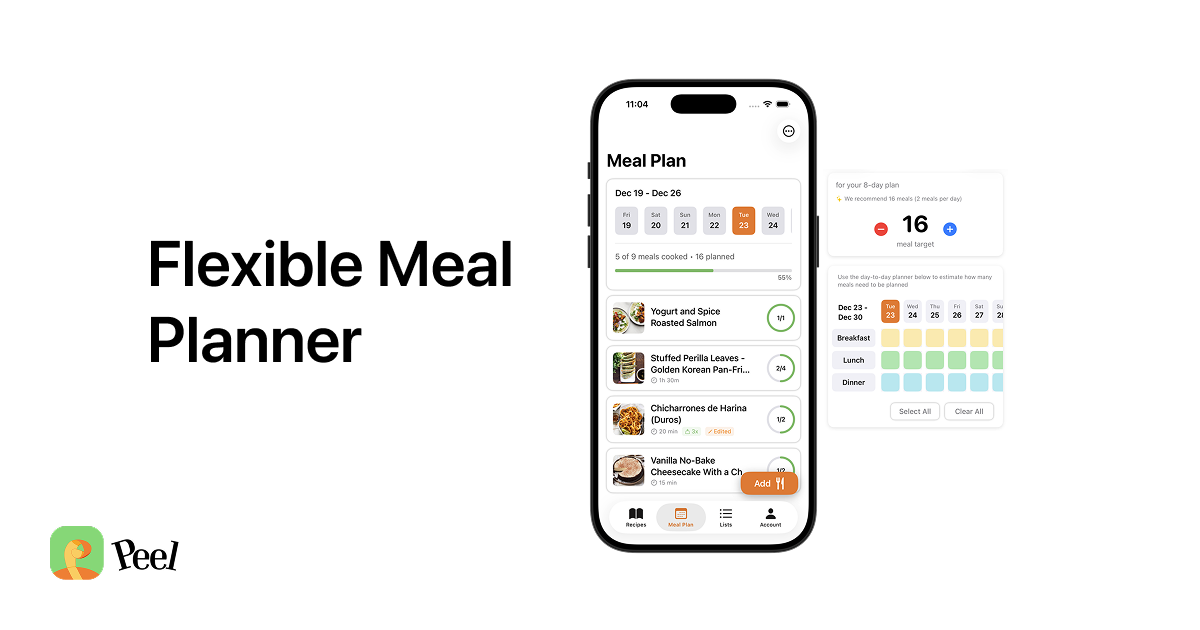
Peel uses a meal pool instead. You add recipes to your pool for the week and cook them in whatever order makes sense. No assigned days, no guilt when you swap meals around, no wasted plans when your schedule changes.
Here's what that looks like in practice:
Save recipes from wherever you find them. See a 15-minute post-shift meal on TikTok? Share it to Peel and the app extracts the ingredients and steps from the video. Find a good meal-prep recipe on Instagram? Same thing. Peel pulls the recipe out of the video so you have it in a searchable, usable format.
Build your pool based on your shift pattern. Working a stretch of nights? Add your pre-shift meals, a couple of pack-and-go options, and a fast post-shift recipe to your pool. Rest days coming up? Add the more involved recipe you've been wanting to try.
Generate one grocery list from your pool. Instead of buying ingredients for seven specific meals, your grocery list reflects whatever's in your pool. Peel combines duplicate ingredients automatically, so you don't end up with three cans of tomatoes when you only need one.
Share with your household. If you live with a partner or family, they can see what's in the pool too. When someone asks "what should I make for dinner?" while you're at work, the pool has the answer.
A sample week for a rotating shift worker
Here's how this might look for a nurse working three 12-hour night shifts (Sun-Tue), then off Wed-Fri:
Sunday (night shift starts): Pre-shift, eat a grain bowl at 5:30pm. Pack a mason jar salad and a protein box for mid-shift eating. Post-shift Monday morning, eat overnight oats you prepped before leaving.
Monday-Tuesday (continuing nights): Same pattern. Pull different options from the pool each day so you're not bored. Post-shift Tuesday morning, eat eggs and toast.
Wednesday (first rest day): Sleep in, eat a late breakfast. In the afternoon, cook that stew recipe from Instagram. Eat dinner with your family. Portion out leftovers for next shift stretch.
Thursday-Friday (rest days): Cook normally. Try a new recipe. Do a grocery run. Prep some components for the next round of shifts (wash and chop vegetables, cook a batch of rice, hard-boil eggs).
The recipes don't change much. The timing and selection do.
Quick wins for shift workers starting today
You don't need an app or a full system to start eating better on shift work. Here are some immediate changes:
Keep a locker/bag stash. Non-perishable foods that live at work or in your bag: nuts, protein bars, instant oatmeal, dried fruit, peanut butter packets. This is your backup for the days your planning fails.
Prep components, not complete meals. Instead of making five full meals, cook building blocks: a pot of rice, grilled chicken, washed salad greens, roasted vegetables. Assemble different combinations each day.
Use your freezer more. Soups, stews, burritos, and casseroles freeze well. Make a double batch on rest days and freeze half. Future-you after a 12-hour shift will be grateful.
Stop trying to eat "normally." There's no rule that says you need breakfast food at breakfast time or dinner food at dinner time. If you want leftover pasta at 4am, eat leftover pasta at 4am. What matters is that you eat real food, not when you eat it.
Your schedule is irregular. Your meals don't have to be chaotic.
The core insight is simple: stop trying to fit your meals into a system designed for people with predictable schedules. Build a system around how you actually work.
Collect recipes that match your eating scenarios. Keep a small rotation for each one. Shop for flexible ingredients. Use rest days to cook and prep. Have a 3am backup plan.
If you want a tool to help, Peel's free tier lets you save recipes from TikTok and Instagram, build a meal pool, and generate grocery lists. The flexible pool format was built for exactly this kind of irregular schedule. Premium is $2.99/month or $29.99/year if you want shared lists and unlimited imports.
But the system works with or without an app. The key is thinking in scenarios, not in calendar days.
Last updated: March 2026