Think about your last grocery trip. The spinach you bought with good intentions. The chicken thighs that sat in the fridge a day too long. The half-used jar of something that migrated to the back shelf and quietly expired.
According to Rutgers NJAES, the average American household throws out one in every four bags of groceries. That adds up to $1,866 per year going straight into the trash.
Food waste isn't just an environmental problem (though it's that too). It's a personal finance problem hiding inside your refrigerator. And meal planning is the single most effective tool for fixing it.
But here's the catch: not all meal planning works equally well. The kind of planning that actually reduces waste looks different from what most apps and spreadsheets tell you to do.
Our meal planning app comparison shows which tools connect recipes, realistic plans, and grocery lists instead of treating them as separate chores.
The numbers behind your grocery waste
Let's start with what we're dealing with.
The EPA estimates that wasted food costs the average American about $728 per person per year. For a household, Rutgers puts it at $1,866 annually. RTS, which tracks waste industry data, estimates the total US food waste problem at roughly 60 million tons per year, valued at around $218 billion.
Where does it go? Mostly to landfills. The USDA says households are the single largest source of food waste in the US, ahead of restaurants and grocery stores.
A ReFED/NielsenIQ survey from November 2025 found that 45% of Americans are already using leftovers more and 40% are more conscious about using fresh foods before they spoil. Rising grocery prices are driving this shift. ReFED's 2026 forecast expects these behaviors to grow enough to measurably reduce consumer food waste this year.
So people care. The awareness is there. What's missing is a system.
Why food waste actually happens at home
Most food waste content stops at "plan your meals and make a list." That advice isn't wrong, but it skips the real question: why does food go to waste even when you went grocery shopping with a plan?
Three reasons keep coming up:
Aspirational buying. You planned five dinners, bought ingredients for all five, then ordered takeout twice because you were tired. The ingredients for those two uncooked meals rot. This is the most common pattern. You didn't waste food because you forgot to plan. You wasted food because you planned meals you weren't motivated enough to actually cook.
Mystery ingredients. You bought cilantro for one recipe and now half a bunch is wilting in your crisper drawer. Single-recipe ingredients that don't get used elsewhere are a consistent waste driver. The USDA notes that produce is the most wasted food category in American households.
The "I'll figure it out" shopping trip. You went to the store without a plan, bought what looked good, got home, and realized nothing goes together into an actual meal. Three days later, ingredients expire. A peer-reviewed study published in ScienceDirect (March 2024) confirmed that "careful weekly meal planning can help reducing household waste and the carbon footprint of diets."
Each of these has a specific fix. Not generic "plan better" advice, but a workflow that addresses the root cause.
How meal planning breaks each waste pattern
Fix for aspirational buying: plan from recipes you already want to cook
This is the most important point in this entire article. When an app generates a meal plan for you, or you pick recipes from a database because they seemed healthy, there's a motivation gap. You didn't choose those meals because they looked amazing. You chose them because you felt you should.
Then Wednesday hits, you're exhausted, and the planned dinner feels like homework. So you order pad thai instead. The chicken and broccoli you bought for the planned stir-fry go to waste.
Compare that to planning with recipes you saved yourself from TikTok or Instagram, things that stopped your scroll because they genuinely looked good. Your motivation to cook those meals is intrinsic. You actually want to eat what you planned.
A survey of 2,568 meal planners found they reduced food costs by an average of $47 per person per month, or $564 per year. The savings came from less food waste, fewer impulse purchases, and fewer delivery orders. The key word is "less," not zero. Realistic planning beats perfect planning.
Fix for mystery ingredients: plan meals that share ingredients
When you can see all your planned recipes side by side, you notice overlap. That bunch of cilantro goes in the tacos on Tuesday and the Thai salad on Thursday. The half-can of coconut milk left from curry works in tomorrow's smoothie.
This is hard to do with recipes scattered across screenshots, bookmarks, and browser tabs. It becomes obvious when your recipes are in one place with a combined grocery list.
Fix for unplanned shopping: generate your grocery list from your meal plan
The simplest waste reduction tool is a grocery list built directly from the recipes you're planning to cook. Not a general list you wrote from memory, but an exact list with quantities pulled from actual recipes. You buy what you need, nothing more.
This is where organizing your recipes digitally pays off. When recipes have structured ingredient lists, your grocery list can be generated automatically instead of estimated from memory.
The meal pool approach to reducing waste
Rigid meal planning, where you assign specific recipes to specific days, can actually increase waste when life doesn't go as planned. You bought ingredients for Monday's dinner, but Monday turned into a late night at work. Now those ingredients compete with Tuesday's plan for fridge space, and something loses.
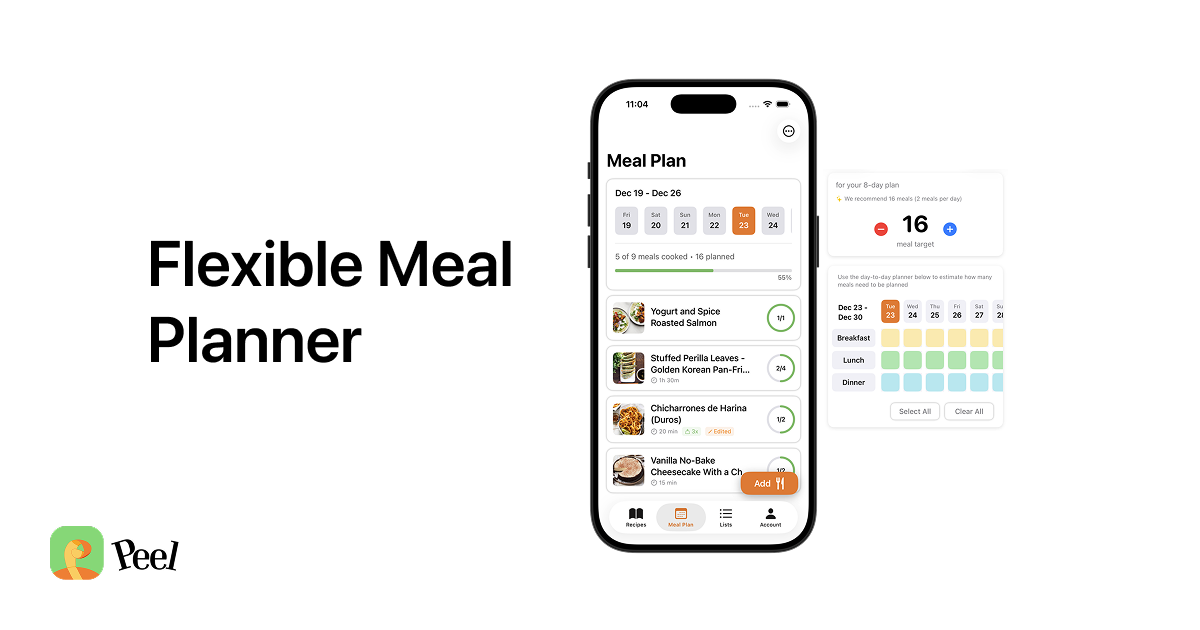
The flexible meal planning method takes a different approach. Instead of assigning meals to days, you build a pool of 4-5 recipes for the week. Your grocery list covers all of them. Each night, you pick whichever recipe fits your mood and energy level.
Nothing goes to waste because of schedule changes. You're still cooking from the same ingredient pool whether you cook the salmon on Tuesday or Thursday. The food gets used either way.
This is the behavioral insight that most food waste advice misses: flexibility is the actual mechanism that prevents waste, not discipline.
I built the meal pool after running into this exact problem. I'd plan Monday through Sunday, feel organized, and then Thursday night something would come up. The plan would fall apart, and it didn't just feel inconvenient. It felt like failure. I realized later that rigid planning isn't just a personal productivity problem. It's a food waste problem. You bought groceries for a week that didn't survive contact with real life. The pool fixes both at once: you cook what works that night, and nothing in your fridge is waiting on a slot that no longer exists.
What the savings actually look like
Let's make this concrete. Say you're a household of two spending $680 per month on groceries (close to the USDA moderate plan).
If you're wasting 25% of that (the national average), you're throwing away about $170 per month, or $2,040 per year.
Meal planners who stick with it consistently report reducing food waste by 40-60%. Even at the conservative end, that's $68 per month back in your pocket. Over a year, $816.
Add in fewer impulse buys (planned shoppers spend less per trip) and fewer delivery orders (when you have a dinner plan, the temptation drops), and total savings easily reach $100+ per month.
A meal planning app like Peel costs $2.99 per month. The math isn't complicated.
Getting started without overcomplicating it
You don't need to plan every meal to see results. Here's a minimal approach that still cuts waste:
Start with 3-4 dinners per week. Not seven. Leave room for eating out, leftovers, and improvisation. Planning fewer meals that you actually cook beats planning seven meals and cooking four.
Save recipes you genuinely want to make. Browse TikTok, Instagram, or your favorite food blogs. When something makes you think "I'd actually eat that," save it. Build a collection over time. The goal isn't a perfect week. It's a growing library of meals your family actually eats, so your shopping list matches the reality of how you cook, not an aspirational version of it.
Pick from your collection each week. Sunday evening, choose 3-4 recipes from your saved collection for the week. Add them to your meal pool.
Generate one grocery list. Buy exactly what those recipes call for, plus your usual staples. That's your shopping trip.
Cook what sounds good each night. Don't force Tuesday's plan on a Thursday mood. The food is all there. Pick what works.
This system works because it's built on recipes you chose because they appealed to you, not because an algorithm recommended them. The motivation to actually cook is baked in, and that's what prevents the waste.
The bottom line
Food waste costs the average American household close to $2,000 per year. Meal planning is the most researched, most effective way to reduce it. But the kind of planning matters.
Planning from your own saved recipes, things you're genuinely excited to cook, works better than AI-generated plans or rigid calendars because you're more likely to follow through. And follow-through is the whole game.
If your grocery trips regularly produce a compost pile of good intentions, it might be worth trying a different approach. Peel lets you save recipes from any website, build a weekly meal pool, and generate a grocery list from it. TikTok, Instagram, and YouTube imports are available on the free tier with a limited allowance (unlimited imports require Premium). The free plan is enough to test whether it changes your shopping habits.
Last updated: March 2026