People use "meal prep" and "meal planning" like they mean the same thing. They don't.
Meal planning is deciding what you're going to eat. Meal prep is cooking some or all of it ahead of time. One is a thinking exercise, the other is a cooking session. You can do either one without the other, and most people would benefit from figuring out which one actually solves their problem before committing to a Sunday afternoon of chopping vegetables. Further down, we'll also cover which meal prep apps are actually worth using, and which ones are just a weekly planner with a different name.
What meal planning actually is
Meal planning is choosing what you'll eat over a set period, usually a week. That's it. You look at your schedule, think about what sounds good, pick some recipes, and make a grocery list.
No cooking required. No containers. No Sunday rituals. Just a plan.
The value of meal planning is that it removes the daily "what's for dinner?" question. According to a 2022 study in the International Journal of Behavioral Nutrition and Physical Activity, people who plan meals eat a more varied diet and are less likely to be overweight. The benefit isn't about restriction. It's about not standing in front of the fridge at 6 PM with no ideas and ending up ordering takeout again.
A meal plan can be as simple as a list on your phone:
- Monday: that pasta from TikTok
- Tuesday: leftover pasta
- Wednesday: stir fry with whatever vegetables are about to go bad
- Thursday: tacos (always tacos)
- Friday: eating out
That's a meal plan. It doesn't need to be fancy.
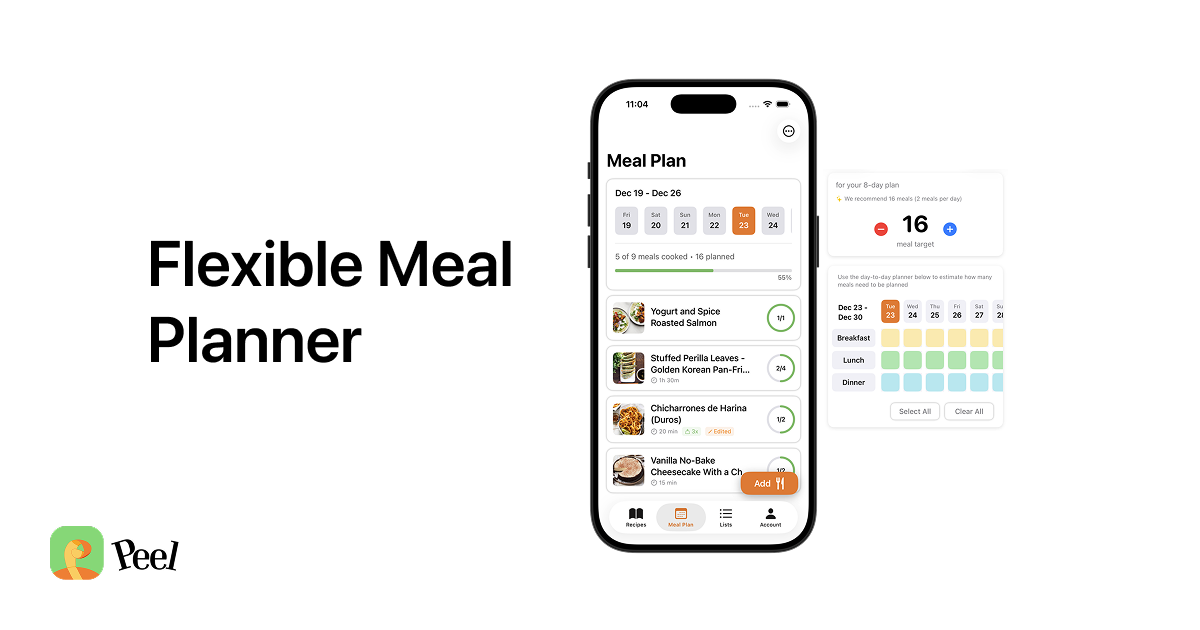
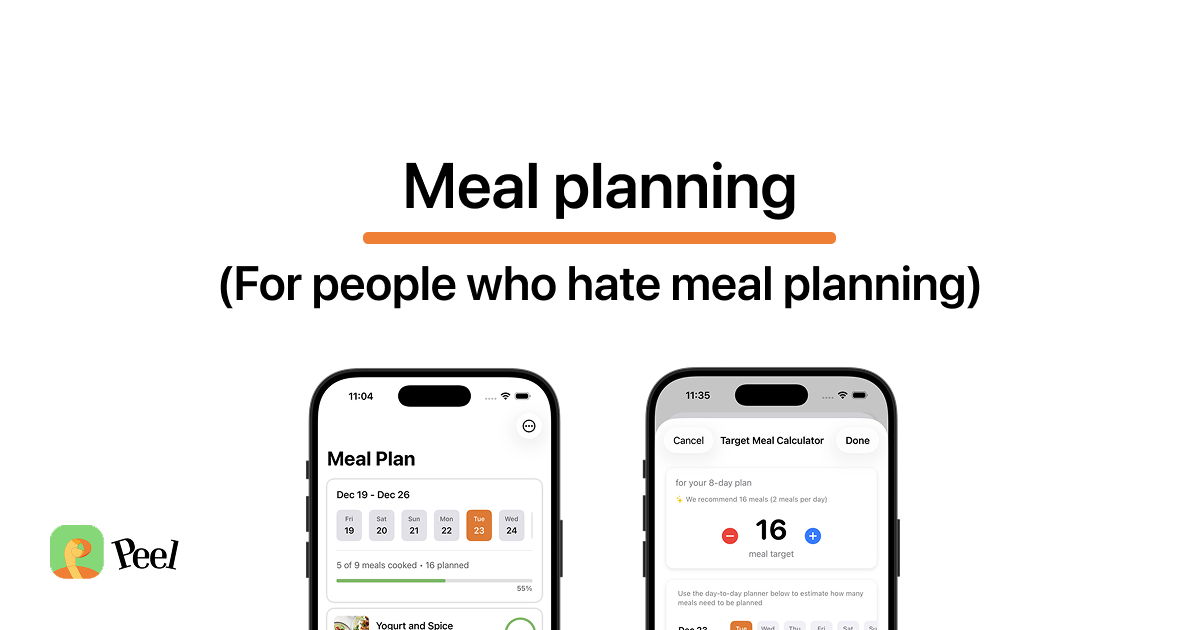
Build a meal plan in Peel → Save recipes from anywhere, add them to a pool, and get a grocery list automatically.
What meal prep actually is
Meal prep is cooking food in advance so it's ready when you need it. The classic version: spend a few hours on Sunday cooking chicken, rice, and vegetables, then portion everything into containers for the week.
There are different levels:
- Full meal prep: Cook complete meals, portion them out, refrigerate or freeze. You reheat and eat throughout the week.
- Ingredient prep: Wash and chop vegetables, cook grains or proteins, make sauces. You still cook each night, but the tedious parts are done.
- Batch cooking: Make a large quantity of one recipe (a big pot of soup, a sheet pan of roasted chicken thighs) and eat it multiple ways throughout the week.
Meal prep works well for people with very predictable schedules who don't mind eating similar food several days in a row. It's popular in fitness communities because it makes tracking macros and calories easier when every meal is pre-portioned.
The actual difference
Here's the simplest way to think about it:
Meal planning = deciding what to eat
Meal prep = cooking ahead of time
Meal planning happens before you shop. Meal prep happens after. You can plan meals without prepping them (just cook each night from your plan). You can prep meals without much planning (cook a bunch of chicken because it was on sale, figure out meals later). They're separate activities that happen to work well together.
When meal planning is enough
For most people, meal planning alone solves the biggest problem: not knowing what to cook.
Meal planning is probably enough if:
- You enjoy cooking and don't mind doing it daily
- Your household has varied tastes (kids who won't eat what you prepped three days ago)
- You prefer fresh meals over reheated ones
- Your schedule varies and you can't predict which nights you'll be home
- You've tried meal prep and found it boring or wasteful
The complaint people have about meal planning is usually that it feels rigid. You plan chicken on Wednesday, but Wednesday rolls around and you want anything except chicken. That's a fair criticism of traditional calendar-style meal planning, and it's why some people prefer a more flexible approach.
One method that addresses this: instead of assigning meals to specific days, you pick 4-5 recipes for the week and cook whichever one fits your mood each night. You still have a plan (and a grocery list), but you're not locked into a sequence. This is sometimes called a "meal pool," and it works well for people who gave up on rigid meal planning because it felt too restrictive.
When meal prep makes more sense
Meal prep is worth the effort when time is your biggest constraint during the week.
Consider meal prep if:
- You're cooking for one or two people with similar preferences
- You work long hours and genuinely cannot cook on weeknights
- You're tracking macros or calories and want consistent portions
- You don't mind eating the same meal several days running
- You want to completely eliminate cooking decisions during the workweek
The fitness community has given meal prep an outsized reputation. Rows of identical containers on Instagram look impressive, but that level of prep isn't necessary for most people. Partial prep, where you prepare ingredients but assemble meals fresh, gives you most of the time savings with more variety.
When to do both
The most practical approach for a lot of people is a combination: plan your meals for the week, then do some light prep to make weeknight cooking faster.
That might look like:
- Pick 4-5 recipes for the week (the planning part)
- Make your grocery list and shop
- On Sunday, wash and chop vegetables, cook a pot of rice or quinoa, marinate proteins
- Each night, cook your planned meal using the prepped ingredients (15-20 minutes instead of 45)
This hybrid approach is popular because it's less extreme than full meal prep but more organized than winging it. You eat fresh food every night without the time commitment of cooking from scratch.
Which one actually reduces food waste?
Both, but for different reasons.
Meal planning reduces waste because you buy what you need for specific recipes instead of vaguely filling your cart with "healthy stuff" that rots in the crisper drawer. The USDA estimates that American households waste about 30-40% of their food supply. Most of that waste comes from buying without a plan.
Meal prep reduces waste because you cook perishable ingredients before they go bad. That bunch of cilantro won't wilt if it's already in your prepped rice bowls.
The planning step matters more here. Without a plan, prepping food is just cooking a lot of food you may or may not eat. The plan makes the prep intentional.
What About Meal Prep Apps?
Meal prep itself doesn't need an app. A timer and some containers will do. But the planning that feeds your prep session (deciding what to cook, generating the grocery list) is where an app actually helps, and the options aren't all built the same way. Eat This Much is the closest thing to a dedicated meal-prep app, its free tier generates daily, macro-based plans that fitness and batch-cooking communities use to hit consistent portions. Mealime and Plan to Eat both auto-generate a weekly plan with a grocery list you can batch-shop from, then you do the actual prepping and portioning yourself. None of them prep the food for you, that part's still on you.
| App | Free tier | Premium price | Platforms | Where it fits meal prep |
|---|---|---|---|---|
| Eat This Much | Daily macro-based meal plans, food tracking. No automatic grocery list or week-long planning on free | $5/mo (billed annually) | iOS, Android, Web | Macro-based portions, popular for batch cooking |
| Mealime | Auto-generated weekly plan from Mealime's library, grocery list | $5.99/mo or $49.99/yr | iOS, Android, Web | Grocery list you can batch-shop from |
| Plan to Eat | 14-day trial only, no permanent free tier | $5.95/mo or $49/yr | iOS, Android, Web | Weekly plan and list, not actually free |
| Paprika | No free tier | $4.99 one-time | iOS, Android, Web, Mac, Windows | Recipe storage, manual planning |
| Ollie | 7-day trial only, no permanent free tier, card required to start | $10/mo or $7/mo annual | iOS, Android | Family weekly plans, not actually free |
| Peel | Unlimited recipe storage, unlimited web imports, meal planning, grocery lists, weekly-refreshing social import credits | $2.99/mo or $29.99/yr | iOS | Organizing recipes from anywhere before a prep session |
Try Peel free → Not a meal-prep app itself, but a place to gather the recipes you're about to prep from.
Peel isn't meal-prep-specific, it doesn't track macros or portion sizes. I get asked about that occasionally, and the honest answer is I built Peel for people figuring out what to cook, not for tracking what they eat. If macro tracking is what you need, Eat This Much does that better than I ever intended Peel to. But if your recipes are scattered across TikTok saves, Instagram bookmarks, and screenshots, having them organized in one place before you sit down to plan your prep list makes the whole process faster, which makes the whole system more sustainable.
For a broader look at how the main meal planning apps compare beyond just meal prep, see our full 2026 meal planning app comparison.
Start with the one that solves your actual problem
If your problem is "I never know what to cook," start with meal planning. You'll buy less random food, waste less, and eliminate the 6 PM panic.
If your problem is "I don't have time to cook during the week," start with meal prep. Even basic ingredient prep on Sunday can cut your weeknight cooking in half.
If both are problems, plan first, then prep. The plan makes the prep useful, not the other way around.
And if you've tried both and keep falling off, the issue might not be discipline. It might be that your system is too rigid for how you actually live. A flexible approach, where you have a loose plan but freedom to swap things around, tends to stick longer than a strict schedule.
Originally published March 2026. Updated August 2026.